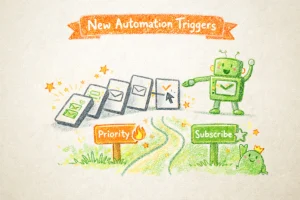
Triggers are not just automation tools. They are decision engines inside your email system.
When configured properly, triggers respond to behavior, dates, and list changes in real time. They move contacts between stages, notify teams, and deliver messages at precisely the right moment without manual intervention.
If you need step-by-step setup instructions, see the Trigger Configuration Guide.
Below are practical, real-world examples that demonstrate how to use triggers strategically, not just technically.
1. Contract Renewal Reminder That Prevents Revenue Loss
Many businesses rely on subscriptions, licenses, or service agreements that expire annually. Forgetting to follow up before renewal means leaving revenue at risk.
The objective
Send renewal reminders automatically before a contract or subscription expires.
How it works
- Add a custom date field called Renewal Date
- Store the contract expiration date for each contact
- Create a trigger:
- Type: Based on Contact’s Date Field
- Field: Renewal Date
- Timing: 30 days before → Every anniversary
- Action: Send Renewal Reminder Email
Optional follow-up triggers can send additional reminders 7 days before expiration or on the expiration date itself.
2. Turning Email Opens Into Qualified Leads
Not every contact is equally engaged. Triggers allow you to respond to behavior in real time.
The objective
Move engaged contacts into a warmer list and follow up while interest is high.
How it works
- Send a product introduction campaign
- Create a trigger:
- Type: Based on Email Campaign Opened
- Campaign: Product Introduction
- Timing: When
- Actions:
- Send follow-up email
- Add to Warm Leads list
- Remove from Cold Leads list
Why it matters
The system automatically segments contacts based on behavior. No exports. No manual tagging. No delay.
Advanced variations
- Wait one day before sending the follow-up
- Create different triggers for different product emails
- Notify sales for enterprise-tier prospects
This is how marketing automation becomes pipeline automation.
3. Behavioral Lead Scoring Inside Autoresponders
Autoresponder sequences are powerful. Triggers make them intelligent.
The objective
Identify contacts who engage deeply inside a multi-email sequence.
How it works
Create triggers that respond to behavior within the sequence:
- If Email #3 is opened → Add to Engaged Leads
- If pricing link is clicked → Add to Hot Leads and notify sales
Why it matters
You are not waiting until the sequence ends to determine interest. The system reacts immediately to high-intent signals.
Sales is alerted at the moment of engagement, not days later.
4. Immediate Welcome Automation
Speed matters. When someone subscribes, the first few minutes set expectations.
The objective
Send a welcome email immediately and organize the contact correctly.
How it works
Create a trigger:
- Type: Based on List Subscription
- Timing: When
- Actions:
- Send Welcome Email
- Add to All Customers list
- Add to Preferences list
Why it matters
The contact receives confirmation immediately, and your internal list structure stays organized automatically.
5. Automatic VIP Identification
Triggers are especially powerful when combined with segments.
The objective
Identify high-value customers and elevate their experience automatically.
How it works
- Create a segment for customers who exceed purchase thresholds
- Create a trigger based on Segment Subscription
- Actions:
- Send VIP onboarding email
- Add to VIP list
- Notify account manager
Why it matters
Customers become VIPs dynamically. As soon as their behavior qualifies, the system reacts. No manual review required.
You are aligning customer value with internal response automatically.
6. Time-Based Campaign Precision
Some campaigns must go out at exact times.
The objective
Send a Black Friday teaser exactly one week before the event.
How it works
- Create a trigger:
- Type: Based on Specific Date
- Date: Black Friday
- Timing: Seven days before
- Action: Send Teaser Campaign
Why it matters
The system handles calendar precision without requiring manual scheduling every year.
For recurring events, use the “Every anniversary” option and the campaign runs annually.
7. Multi-Action Workflow From a Single Click
Triggers are not limited to one action. They can execute full workflows.
The objective
Respond instantly when someone clicks “Request Demo.”
How it works
Create a link-click trigger:
- Type: Based on Link Clicked
- Campaign: Product Newsletter
- Link: Request Demo
- Actions:
- Send confirmation email
- Add to Demo Requested list
- Add to Sales Pipeline list
- Remove from Prospects
- Notify sales
Why it matters
One click initiates a complete internal workflow. The contact receives confirmation, list structure updates automatically, and sales is notified in real time.
No CRM export required.
Strategic Principles for Using Triggers Effectively
Triggers work best when designed intentionally.
- Keep logic simple.
Overlapping triggers can create confusion if not documented. - Respond to behavior, not assumptions.
Use opens and clicks as qualification signals. - Use segments strategically.
Segment-based triggers allow dynamic movement as contact data changes. - Test before activating.
Verify email content and notification logic before enabling triggers. - Monitor execution.
Review trigger statistics periodically to confirm performance.
For detailed setup instructions, field explanations, and trigger types, refer to the Trigger User Documentation.
Final Perspective
Triggers are not just automation conveniences. They are the foundation of responsive marketing systems.
Instead of scheduling campaigns manually or reviewing lists weekly, you define rules once and allow the system to operate continuously.
When configured thoughtfully, triggers reduce manual workload, improve response time, and align marketing activity with actual contact behavior.
That is when automation stops being a feature and becomes infrastructure.